The Intersection Where Anti-Racism and Healthcare Meet

Tipping Points

Changing organizational culture is part of shaping anti-racist healthcare organizations. These “tipping points” led to organization-wide change.

The views expressed here do not necessarily reflect the views of the Robert Wood Johnson Foundation.

Community Solutions for Health Equity, Cancer Patients Alliance | Salinas Valley, CA

Migrant farmworkers in “the salad bowl of America” who received a cancer diagnosis often returned to their origin countries prepared to die. Cancer Patients Alliance and Community Solutions for Health Equity worked with the community to advocate for local cancer treatment options.

The food on our tables, our clothes, and the plants used to develop medicine all begin with farmworkers. Salinas Valley farmworkers, for example, are major harvesters of agricultural goods, producing nearly 70% of U.S. vegetables and fruits. 

“If you’ve had a berry or a leafy green, it was likely harvested by migrant farmworkers in Salinas Valley,” said Lluvia Del Rio, program manager at Cancer Patients Alliance (CPA). “The area is rich in resources, but healthcare access remains challenging, especially for Latinos.”

In Salinas, an urban area nicknamed “the salad bowl of America,” nearly 81% of the population is Latino.

Cancer is the leading cause of death for Latinos in the United States, but the local county hospital did not provide oncology services, making cancer care inaccessible. Furthermore, agricultural work puts Latino farmworkers at increased risk of cancer from exposure to pesticides.

“Upon diagnosis or even suspicion of cancer, Latinos returned to their countries of origin in preparation to die because they did not think treatment was available,” said Dale O’Brien, MD, MPH, executive director of CPA.

Understanding the inequities in cancer care and education, CPA raised awareness of cancer symptoms and screenings in the community and demanded the county offer treatment locally. The organization built trust and community power with local Latinos through partnering with Community Solutions for Health Equity (CSHE), a national collaborative focused on engaging community members to transform local healthcare systems.

“What stood out immediately was CPA’s commitment to addressing not only cancer education, but also centering community voices,” said Alexis Major, deputy director at CSHE. “Community members didn’t just share their lived experiences. They identified barriers, informed solutions, and shaped the initiative’s direction, which is invaluable.”

CSHE and CPA launched a storytelling project with local Latinos impacted by cancer to raise awareness of cancer care gaps, demonstrating the importance of community engagement in transforming health systems. Their efforts helped establish a local infusion center for cancer treatment, shifted district hospital policies on cancer outreach, and educated Latinos in advocating for better care.

This initiative continues to inform CPA and CSHE’s work to partner authentically with communities and address health disparities. Read more about the partnership here.
Yellowhammer Fund, Chocolate Milk Mommies, Margins: Women Helping Black Women, The Alabama Birth Center, and Oasis Women’s Health | AL

When Alabama prohibited midwifery in 1976, the state had more than 300 mostly-Black midwives. Today there are roughly 40. The Alabama Birth Equity Initiative (ABEI) is a coalition working to change that.

ABEI aims to improve access to care for women in Alabama amid increased rural hospital closures and a statewide abortion ban.

“We see the disparities across the entire system as it relates to access and outcomes for both mothers and babies in the State of Alabama,” said Heather Skanes, MD, OBGYN, and CEO of Oasis Women’s Health. “There is limited access to Black midwives, OBGYNs, and doulas for people of color, especially those who live in rural areas.”

Understanding the maternal health landscape and those working to improve it, Jenice Fountain, executive director of the Yellowhammer Fund, brought together a group of organizations improving maternal health outcomes and access to create the Alabama Birth Equity Initiative (ABEI). The initiative consists of Chocolate Milk Mommies, Margins: Women Helping Black Women, The Alabama Birth Center, and Oasis Women’s Health.

The goal of ABEI is to improve maternal and infant mortality in Alabama by creating a pathway to train and produce more skilled licensed midwives, increase the deployment of mobile health units into rural areas, and boost advocacy efforts to expand prenatal access and funding for birth centers. Alabama currently has roughly 40 black midwives—a number the initiative is looking to increase by 10 within a year.

“Because our goals are so big for the state, we needed to come together to bring more funding to Alabama and create a process to properly disperse it, not just for our organizations, but for the community as well,” said Dr. Skanes.

ABEI is excited about what lies ahead. The coalition is hosting meetings for aspiring midwives to assess needs and determine scholarship eligibility—including support for coursework, childcare, and transportation—while planning advocacy efforts to address barriers to care like insurance coverage. Learn more about the initiative and stay up to date on ongoing efforts by visiting their website.

RUSH University Medical Center | Chicago, IL

A medical center signed on as a local business’ first customer to drive economic investment and improve local job opportunities.

While vibrant communities rely upon local businesses that support their economic growth and wellbeing, community institutions often engage vendors that are outside of the community/city to produce and deliver local products and services. As a member of West Side United (WSU)––a coalition that brings together diverse organizations with local residents to drive economic investment and community development––RUSH University Medical Center (RUSH) advanced its mission to foster systemic change by supporting the Fillmore Linen Service on Chicago’s West Side.

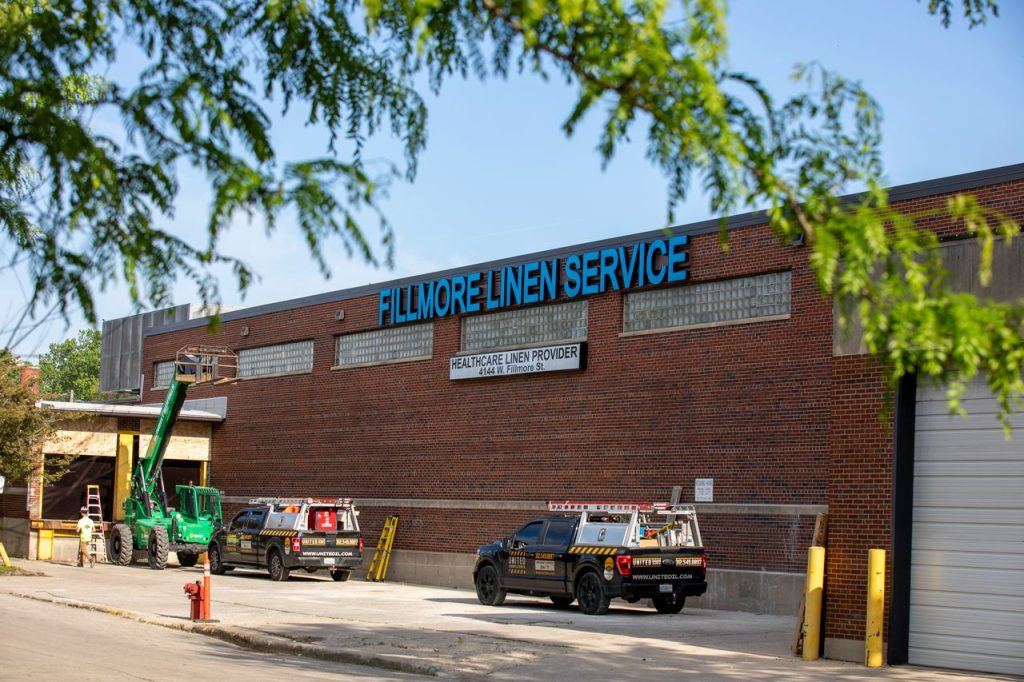
The Fillmore Linen Service in Chicago, IL. Photo provided by: WSU

“If you want to address the economic vitality of residents, you’ve got to think about the unemployment in the zip codes that are impacted,” said Ayesha Jaco, executive director of WSU.

The Fillmore Linen Service launched in 2024 in North Lawndale, a West Side neighborhood faced with longstanding racial inequities, disinvestment, and limited job opportunities. The mission was to restore a previously vacant building and create several hundred community jobs. Prior to the Fillmore Linen Service’s opening, RUSH sent more than six million pounds of linen out of state for laundering each year.

“Every dollar that’s invested locally has a multiplier effect,” said Rukiya Curvey Johnson, RUSH’s vice president of community health equity and engagement. “By supporting neighborhood jobs, you’re providing stable household income, while addressing some of the factors that affect health and life expectancy.”

Local residents were hired to operate the 45,000 square foot, state-of-the-art laundry facility with investments from philanthropic funding. RUSH, one of the largest employers on Chicago’s West Side, signed on as the first customer, bringing credibility to the enterprise. As a convener, WSU helped recruit the workforce and implement hiring support for residents starting new roles within the facility.

“RUSH serves as an example for other organizations looking to develop this kind of community partnership. The initiative provided job opportunities in a neighborhood with one of the highest unemployment rates in the city,” Curvey Johson said.

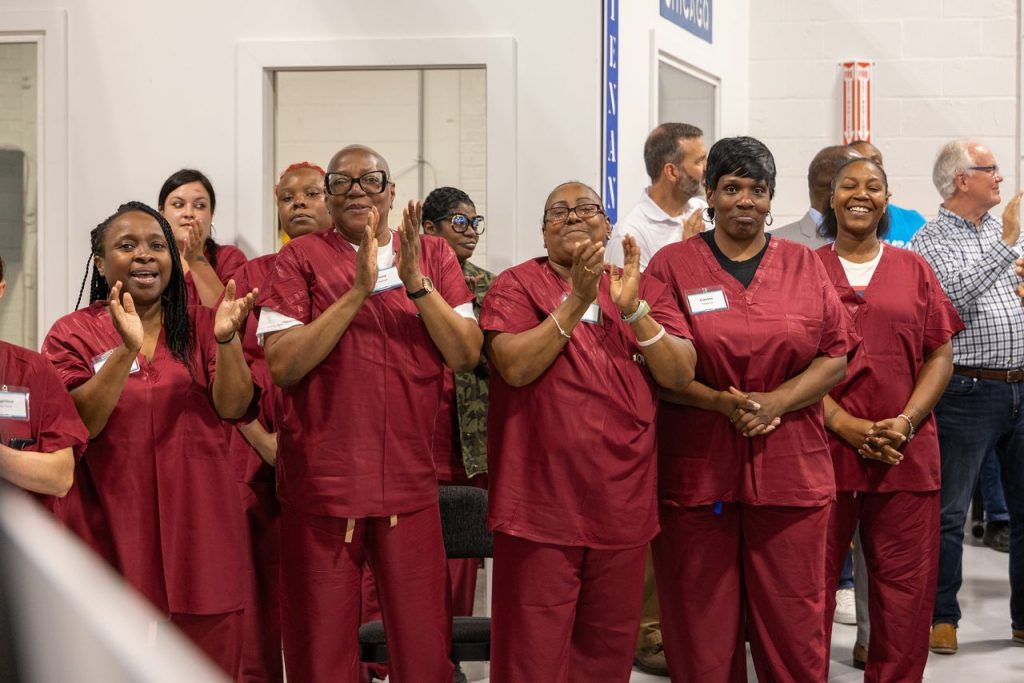
Fillmore Linen Service employees at the business’ ribbon cutting event. Photo provided by: WSU

The goal is for The Fillmore Linen Service to become a hub for community businesses to support the existing and future workforce and create more jobs for Chicago’s West Side residents.

Morgan State University | Baltimore, MD

Researchers at Morgan State University and the National Transportation Center partnered to transform accessibility within airports by developing a new wheelchair.

Everyone should have access to airport travel, but navigating what feels like mile-long terminals and moving walkways can be nearly impossible for people with mobility challenges. A design competition to spur innovation and equity in accessibility led researchers at Morgan State University’s Center for Equitable AI and Machine Learning Systems (CEAMLS), SMARTER Center (Safety Mobility Advancements Regional Transportation and Economics Research), and the National Transportation Center (NTC)––to develop a wheelchair with the potential to transform accessibility.  

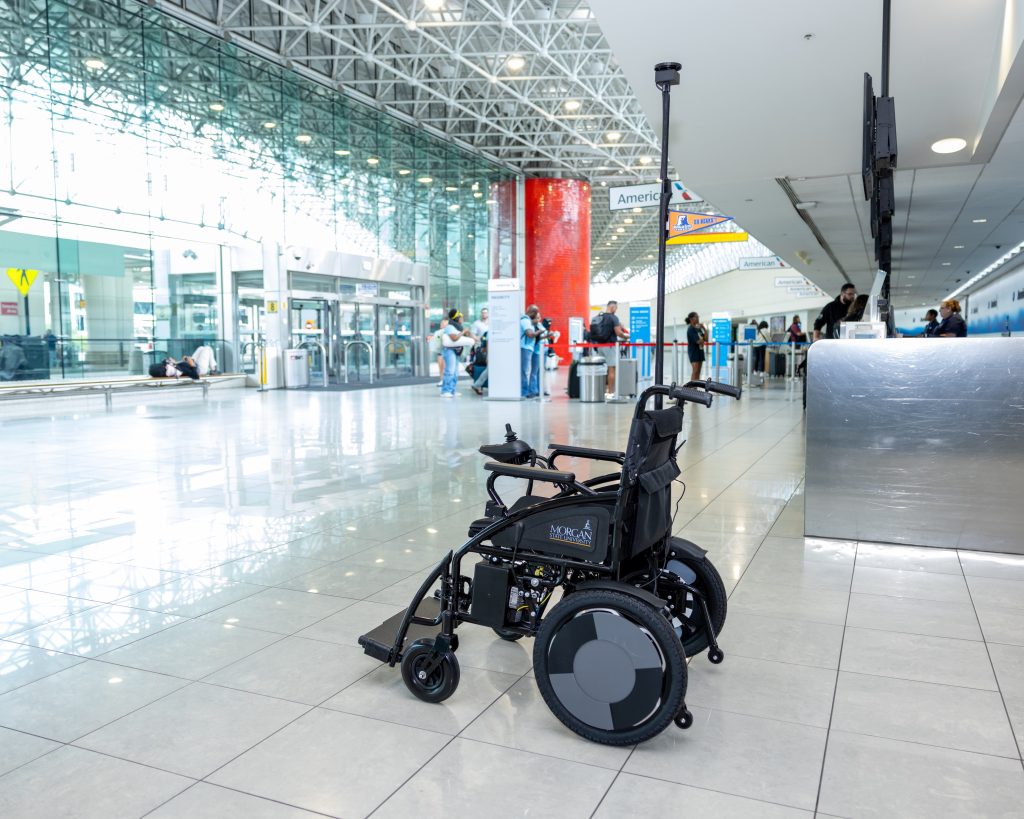
Their self-driving wheelchair uses sensors and pre-mapped routes to help travelers with physical disabilities or impairments affecting movement move freely, safely, and efficiently through the airport.  

Morgan State Autonomous Wheelchair being tested at BWI Thurgood Marshall Airport. Photo provided by: Morgan State University

Individuals use an app to summon a wheelchair. It then scans their ticket and transports them to their departure gate.  

As Kofi Nyarko, PhD, professor of Computer & Electrical Engineering and CEAMLS director at Morgan State, explained, “People with mobility challenges want to be able to get up and go like everybody else, with minimal roadblocks and a sense of autonomy.” 

After testing in the lab, Dr. Nyarko and Mansoureh Jeihani, PhD, director of Morgan State’s SMARTER Center, forged a partnership with Baltimore/Washington International Airport (BWI), where they’re piloting the wheelchair, proving its safety and gaining visibility.  

The advocacy of one BWI employee made the difference for the team, because he connected them with people who had decisionmaking power to approve the pilot. “You need a champion, that one individual who can understand your goal, see your vision, and communicate that vision so that their colleagues see it too,” said Dr. Nyarko.  

To expand, the CEAMLS, NTC, and SMARTER Center teams will need to partner with airlines, which provide wheelchairs to travelers. They envision a future with increased mobility for everyone.  

“This doesn’t have to be limited to airports or to physical immobility,” said Dr. Nyarko. “We’re exploring other environments, like hospitals and campuses, where people want to move freely and confidently through a space, despite how complex or chaotic it is.”

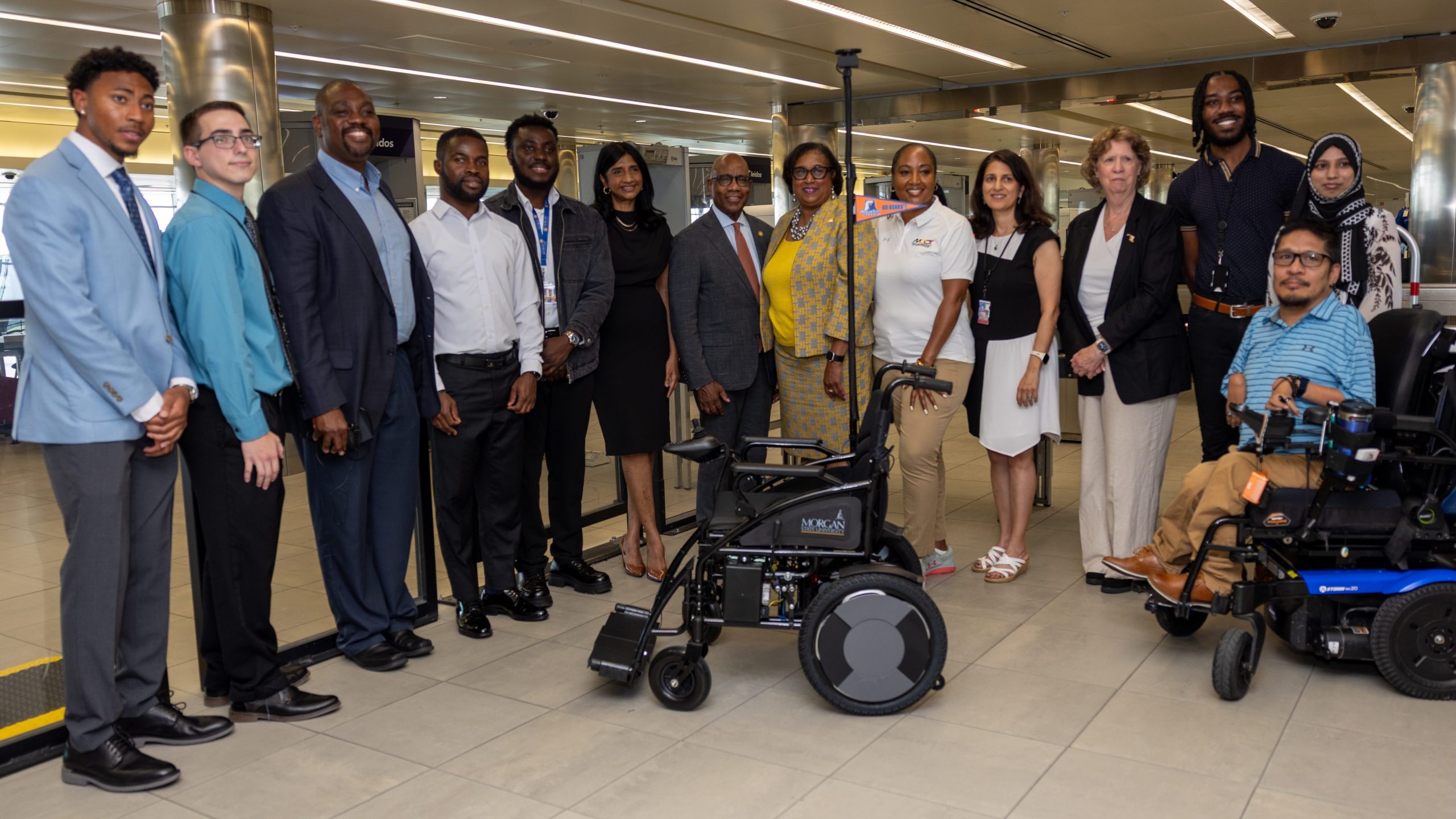
Morgan State student researchers, Dr. Kofi Nyarko, Lt. Governor Aruna Miller, Morgan State President Dr. David Wilson, BWI Airport Executive Director Shannetta Griffin, MDOT Assistant Secretary Juawanna Greene, Dr. Mansoureh Heihani, MD. Secretary of Disabilities Carol Beatty, Student Researchers, and Director Of Transportation Policy and Programs at Maryland Department of Disabilities, Bong Delrosario. Photo provided by: Morgan State University

You May Also Like

Sign up to receive The Intersection's newsletter and hear about upcoming events.

This field is for validation purposes and should be left unchanged.
Name(Required)